Under cabinet light: position, colour temperature and glare
25 June 2026 · Fixtures
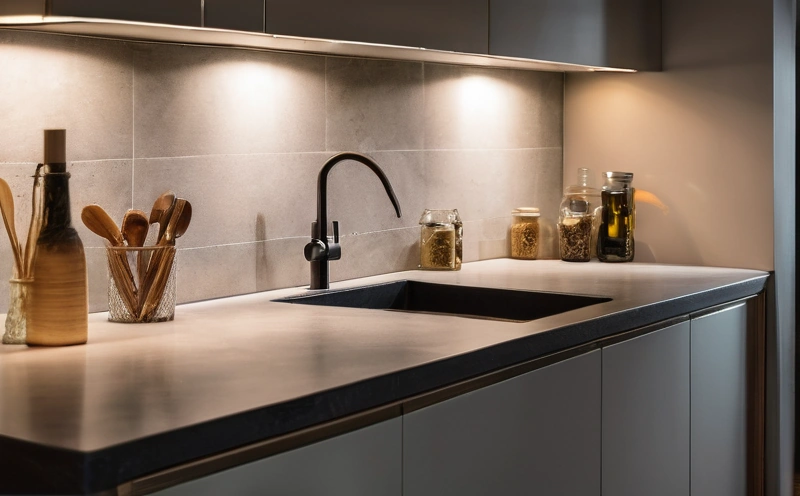
Under cabinet lighting delivers more usable light per dirham than any other kitchen fitting and gets mounted wrong in most installations. Two dimensions decide the result: the setback of the strip from the front edge of the cabinet, and whether an opal diffuser hides the individual diodes from a person standing at the worktop.
How far forward from the back wall should an under cabinet strip sit?
Mount the strip within 40 mm of the front edge of the cabinet underside, not against the back wall. A strip set at the back of a 320 mm deep cabinet lights the splashback and leaves the front 300 mm of a 600 mm worktop in shadow, which is where the chopping board sits.
Front mounting also removes the strip from the sightline. A person of 1.7 metres standing 500 mm from a worktop sees under a cabinet whose underside sits at 1500 mm, so a rear mounted strip points its diodes straight at the eye. The cabinet front rail hides a strip set at 40 mm setback completely.
When does an under cabinet strip need an aluminium profile and diffuser?
Polished stone, quartz and glossy tile reflect a bare strip as a row of separate bright dots, so every strip over a polished surface needs an aluminium profile with an opal diffuser. A 16 by 8 mm surface profile with diffuser costs about 30 AED per metre and turns the dots into one line.
Matt granite, honed marble and timber tolerate a bare strip because a matt surface scatters the reflection. Diode spacing decides the remaining risk: a strip at 60 LEDs per metre shows scalloping through a shallow diffuser, while 120 LEDs per metre reads as a continuous line behind the same 8 mm opal cover.
How many lumens per metre does a kitchen worktop need?
A main cooking kitchen needs 800 to 1000 lumens per metre of strip to reach about 500 lux on a 600 mm deep worktop, measured after diffuser losses. Occasional preparation runs at 500 lm/m for 300 lux, and detailed work such as pastry or fish preparation wants 1200 lm/m for 700 lux.
| Kitchen use | Strip output per metre | Load per metre at 24 V | Lux on a 600 mm worktop | Driver for a 3.6 m run |
|---|---|---|---|---|
| Light preparation, occasional use | 500 lm/m | 5 W/m | about 300 lux | 30 W |
| Main cooking kitchen | 800 to 1000 lm/m | 9 W/m | about 500 lux | 45 W |
| Detailed preparation work | 1200 lm/m | 13 W/m | about 700 lux | 60 W |
Size the driver at 80 per cent of its rated output, so a 3.6 metre run at 9 W per metre draws 32 W and takes a 45 W driver rather than a 35 W one. Running a driver at full rating shortens electrolytic capacitor life and is the usual reason an under cabinet run fails in year three.
Which colour temperature and CRI suit food preparation?
Under cabinet strips belong at 3000 K with CRI 90 and R9 above 50, matched to the ceiling circuit within 200 K. Raw meat, tomatoes and peppers are judged under this light, and a CRI 80 strip with R9 near zero renders red meat brown and leaves salad looking dull.
A 24 V constant voltage strip holds colour better across a long run than a 12 V strip, because voltage drop over 5 metres of 12 V tape shifts the far end warmer and dimmer. Keep any single 24 V run under 5 metres per feed, and inject power at both ends beyond that length.
How should under cabinet light be switched and dimmed?
Put the under cabinet strip on a dedicated switch at the kitchen entrance, separate from the ceiling circuit, and add a dimmer where the kitchen opens to a living space. The same 9 W per metre strip run at 20 per cent gives about 100 lux, enough to cross a dark kitchen at 03:00.
Low level dimming needs a driver specified to 1 per cent rather than the common 10 per cent, at a premium of roughly 60 to 120 AED per driver. A 10 per cent floor still puts 50 lux on the worktop, which reads as a kitchen left switched on rather than a night light. The driver, not the dimmer, sets that floor, which is the subject of dimming without flicker.